Posts

How your DNA can help identify human remains and solve cold cases

Image
You'll find my current recommendations for a DNA testing strategy for Australians if you read the  earlier blogpost.   Most Australians test at AncestryDNA and this is my recommended first step for all family historians. BUT your DNA test at AncestryDNA can't be used by law enforcement and other agencies to identify human remains and solve cold cases. You need to transfer your DNA data to GEDmatch and FamilyTreeDNA to help. You can read more at Louise Coakley's  Genie1 website here. What you need to do if you've tested at AncestryDNA and want to assist:- Download your DNA data from Ancestry DNA. Follow the step by step instructions provided by Louise Coakley under  How to Download Raw DNA Data from AncestryDNA by using this link. Upload your DNA data to GEDmatch  using this link.  Once you've created a free account, you can upload your DNA data at no cost.  Upload your DNA data to FamilyTreeDNA  using this link.  There's no cost for upl...

MODULE 1: Let's talk tree terminology!

Image
Genetic/biological v social/known pedigree The further you go back with your genetic research, the more likely you are to find "unexpected parentage".  When working with DNA, you are researching your genetic pedigree and this is what you should be recording in your tree to get the full benefit of your DNA research.  If it's a sensitive matter, you can make the tree private searchable or unsearchable at ancestry.com .   Note that the Thruline and Common Ancestor features of AncestryDNA will not work if your AncestryDNA test is attached to a private unsearchable tree. You can see my two pedigrees below.  The biological father of my grandfather, James Woodlands, was Cornelius Bray.  His step father was James Woodland and appears in my social/known pedigree.   You can record both the genetic/biological and social/known relationships in your tree but ensure that the genetic/biological is the preferred view. Family view v pedigree view of a tree Click...

AncestryDNA: Shared matches

Image
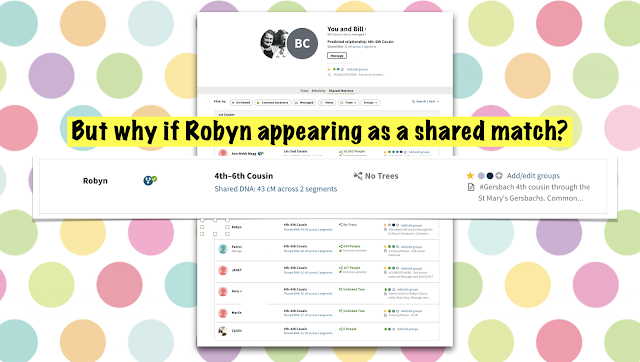
The matches that you share with your AncestryDNA "cousin" can help you work out the common ancestors between you and the "cousin".   BUT it's important to understand that all AncestryDNA is reporting is that the shared march is appealing on both your match list and the AncestryDNA "cousin's" match list.   You can ONLY see which matches you share with 4th cousins and closer.  So you must share 20cM or more with your AncestryDNA "cousin" and the shared match and the AncestryDNA "cousin" must share 20cM or more with the shared match.   Here's an  example from my only match list.  I share 31cM of DNA with Bill.  He's my 3C1R on my maternal M7 Clancy and M8 Flaven lines.  All our shared matches are on that line except Robyn.  I share 43cM of DNA with Robyn.  She's my 4C on paternal P5 Gersbach line.   When I look at my shared matches with Robyn, apart from Bill, they  are on my paterna...

SAG DNA Research Group: Tools in Practice 24 April 2021 - References

Working with chromosome data Why is it important to analyse chromosome data?  What is triangulation?   Gail Bryant, Vicki Hails, Barbara McAlary and Christine Woodlands will lead the discussion.  Here are some references including links to DNA Sydney Blog and Facebook group. Rootstech 2021: Roberta Estes - DNA Triangulation: What, Why and How DNAeXplained: A Triangulation Checklist DNAeXpalined: 23andMe Changes: Triangulation Doesn't Work the Same Way genemonkey25: DNA Research Methodology Jared Smith: Genetic Genealogy using GEDmatch Genie1: How to Download your Raw DNA Data DNA Sydney Blog: Autosomal Analysis DNA Sydney Facebook group MyHeritage: How can I find triangulated DNA segments? My thoughts on DNA testing and transfer strategy for Australians... Veronica's excellent blog post - "Reuniting the Britton family" - an Irish story with plenty of chromosome triangulation!

DNA stories: Evidence and Proof (Notes for the SAG Writing Discussion Group on 12 November 2020)

Image
We all love sharing our DNA stories.  The challenge is what's that DNA we share with our DNA match proving?  This slide from Veronica Williams' presentation at our recent Irish Day is the challenge of genetic genealogy.  Evidence and proof are recurring themes in our AdvanceDNA Discussion Groups particularly when we're going public with our work! Here's a slide I use when introducing DNA....you only need to read the heading as the next two slides tell the story of what's needed to meet the proof standard.  Why not join our DNA sessions and find out more?  Genetic genealogy is a new tool for the family historian and, as I now say, the biggest revolution for the family historian since the invention of paper!  Our understanding of using this tool in our family history is evolving very quickly.   The next slide is a summary of the dot points above.  In essence, the more distant the likely relationship the more evidence is required to prove the relatio...

Chromosome mapping at DNA Painter

Image
Below are notes for those who attended the session at the Society of Australian Genealogists by webinar on 28 August 2020.  Others are welcome to use these notes for their personal research.  Please contact me at chrisw9953[at]gmail[dot]com for other uses.  I'll strive to update the notes as there are further developments or my understanding of the area grows. Chromosome mapping is a methodology that- looks at the autosomal and X-DNA you share with your matches and identifies which ancestor or ancestral couple passed that segment of DNA to you. For males, we map chromosomes 1 to 22 and the X chromosome (at chromosome 23) inherited from the mother.  For females, we map all chromosomes 1 to 23 as females get one X chromosome from their father and one from their mother. Why map chromosomes? It's fun!  We know that we receive 50% of our DNA from our father and 50% our mother.  But how much did we received from e...

SAG DNA Painter 2020 Webinars - Activities and References

Image
1     Activities To undertake these activities, you should register for a free  DNAPainter.com  membership.   Activity 1 - Ancestral Tree tool Using the Ancestral Tree tool- manually prepare your pedigree tree back to your great grandparents, download a picture of the tree and share a copy of the tree to DNASydneyDiscussion[at]gmail[dot]com. Activities 2&3 - What are the odds (WATO) tool Use WATO Version 1 for this case study.   Just do as much as you can.  There will be plenty of time for questions and discussion at our next session.   You can email any questions prior to the next session to DNASydneyDiscussion[at]gmail[dot]com. Research question: What is Gail's relationship to Chris, Deb, John and Rob? This is an example of a DNA dilemma from my family.  You were introduced to the case study during Friday’s session.  At our next session, we’ll take some twists and turns with the case study to look at the WATO tool. What ...